
Your Bag Height Is Set by a Metal Cylinder
You ask for a bag 16 inches tall and get told you can have 15 and a half or 17. It sounds like the supplier being difficult. It is not. On a gravure run your artwork is engraved around a copper cylinder, and the distance around that cylinder sets the repeat. Your bag height has to divide into it, so the available heights come in steps rather than any number you like.
Overview
You have worked out exactly what you need. The kibble fills to a certain level, the shelf it goes on has a certain clearance, and the bag wants to be sixteen inches tall. You send that over and the answer comes back that you can have something slightly under or something slightly over, but not the number you asked for.
That reads as a supplier being rigid, or as a quote being massaged. It is neither. It is a consequence of how the printing actually happens, and once you have seen it you will never read a size conversation the same way again. The constraint is not commercial. It is a piece of metal.
The Artwork Is Engraved Around a Cylinder
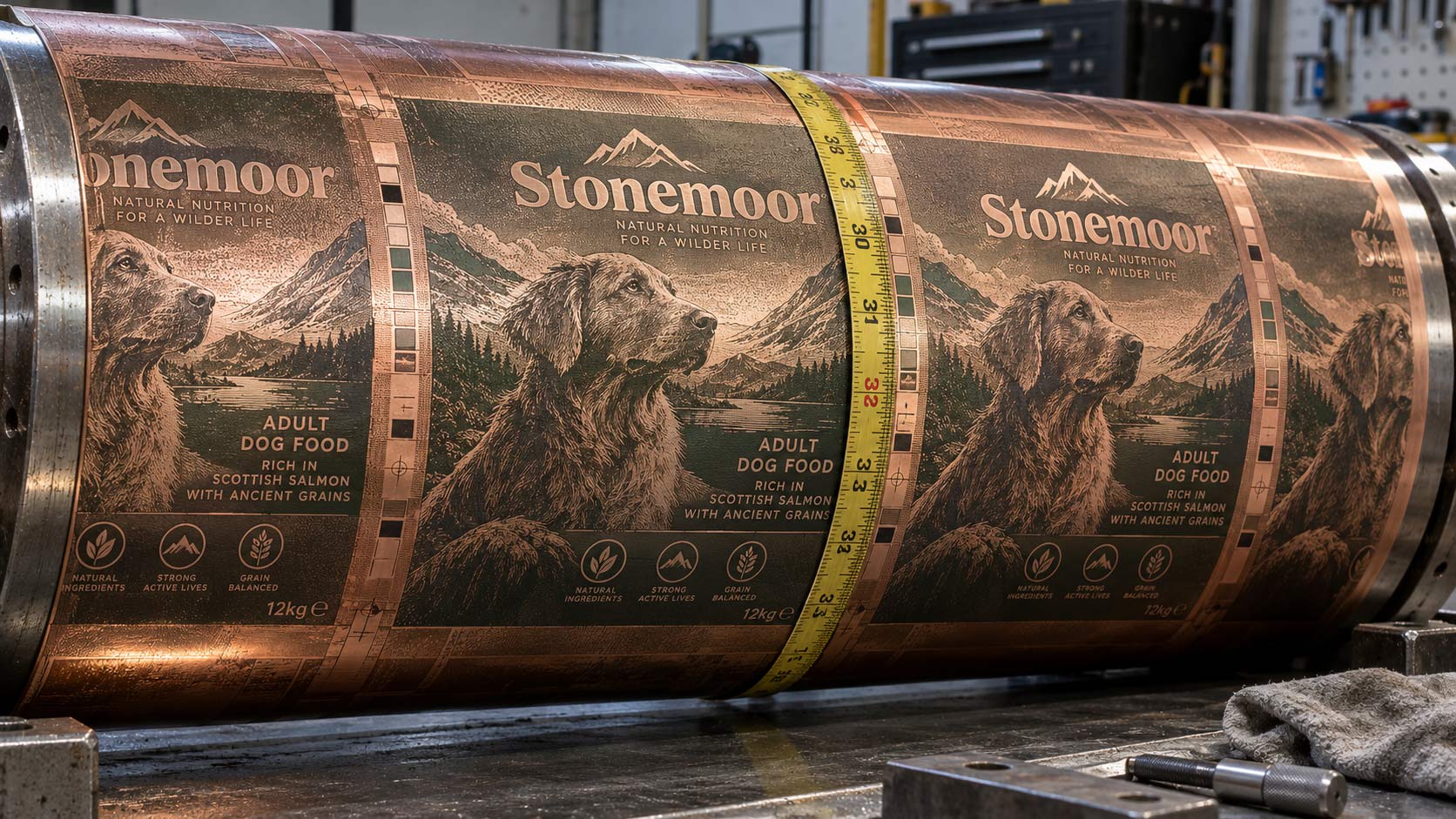
On a rotogravure press the image is not held in a file at the moment of printing. It is physically engraved into the surface of a copper cylinder, one cylinder per color, and those cylinders rotate against the film.
Because the image goes all the way around a cylinder, it repeats every single rotation. The distance around that cylinder is called the repeat length, and it is the exact length of film that gets one full copy of your artwork. Roll the cylinder once, you print one repeat. Roll it a thousand times, you print a thousand identical repeats down the web.
That is the whole mechanism, and the consequence falls straight out of it. Your bag has to fit into that repeat. One bag per repeat, or two bags per repeat, or some other whole number, but it has to divide cleanly. You cannot have two and a bit bags per rotation, because the next rotation starts the artwork again whether your bag was finished or not.
So Heights Come in Steps
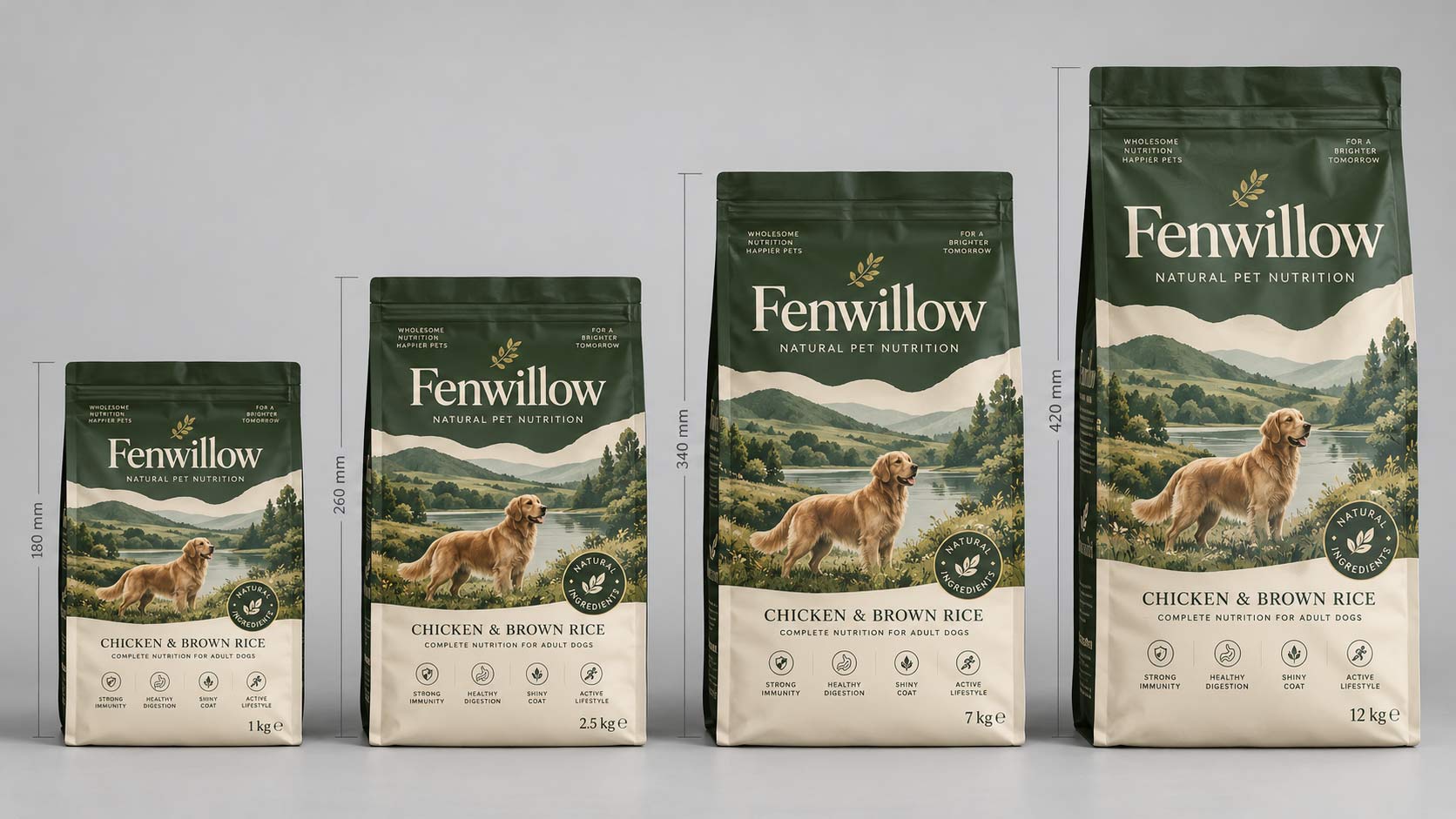
A printing plant does not own a cylinder in every conceivable circumference. It owns a set of them, and each one gives a particular repeat.
Your available bag heights are therefore whatever divides sensibly into the repeats that exist, minus the material the seals and the gussets consume. That produces a list of workable heights with gaps between them, which is why you get offered a number near yours rather than yours exactly.
- The height is the constrained dimension, because that is the direction the film travels.
- Width is far more flexible, because it is set by how the web is slit, not by the cylinder.
- Fitting more bags per repeat is efficient, so smaller sizes often have more options than large ones.
- A new cylinder is possible but it is a real cost, which is why it is not the default suggestion.
- Every color needs its own cylinder, so a bespoke repeat multiplies across the whole set.
None of this applies to the bag's width, its gusset depth, or its features. It is specifically the height, and specifically on gravure.
Why It Reads as a No
From the outside the conversation looks like negotiation, and that is the misunderstanding worth clearing up.
You named a dimension. The supplier came back with a different one. Nothing in that exchange explains itself, so the natural reading is that there is slack in the system and you are not being given it. Push harder and you might get your number.
In reality the person quoting has a list of repeats in front of them and is giving you the closest workable option. The flexibility you are looking for is not being withheld, it is in a tool crib in the form of engraved copper. That is also why the answer changes between suppliers: different plants own different cylinders, so a height that is awkward at one is routine at another.
Digital Printing Does Not Have This Problem
There is a straightforward escape, and it is worth knowing before you compromise on a size that matters.
Digital printing has no cylinder at all. The image goes from file to press, so there is no repeat and no constraint on height beyond the practical limits of the equipment and the dieline. If an exact height genuinely matters, for a shelf, a case fit, or a display, digital removes the obstacle entirely.
The trade is the familiar one. Digital is the right economics at smaller run sizes per design, and rotogravure takes over at high volume where the cylinder cost spreads across enough bags to be irrelevant. So the real question is not which press is better. It is whether your exact height is worth more to you than the per bag saving at your volume.
How to Work With the Constraint
Handled early this is a non-issue. Handled late it forces a compromise on a dimension you had good reasons for.
- Bring your target height to the first conversation, not after the artwork exists.
- Ask what repeats are available and what heights they produce. It is a short list and it is not a secret.
- Say why the height matters, if it does. A shelf clearance or a case fit is a hard constraint and changes the answer; a preference does not.
- Check whether half an inch actually costs you anything. Often it does not, and accepting the nearest step is free.
- Group your sizes thoughtfully. Picking heights that sit on compatible repeats across your range can simplify every reorder you ever place.
If you are planning a range rather than a single bag, this interacts with everything else about sizing, which our post on pet food bag sizes covers from the fill side. A full custom pet food bag specification is where height, repeat and print method get settled together instead of one at a time.
Wrapping It Up: Ask About the Repeat Early
Most packaging constraints are about the product. This one is about a machine, and it is invisible unless somebody tells you.
The useful habit is simply to ask, at the start, what heights are available and why. You will get a list, you will understand where the gaps come from, and you will be able to tell in about a minute whether the nearest option costs you anything real. If it does, digital printing is sitting right there without the constraint. If it does not, you take the nearest step and never think about it again, which is exactly what you want from a detail like this.
Ready to Create Packaging Your Pets (and Customers) Will Love?
Let's bring your brand to life.
Get Started Today