
The Carry Handle on a Big Kibble Bag Is a Hole in Your Barrier
A thirty pound bag needs a way to be carried, and the obvious answer is to cut a handle into the top. That handle is an opening through the bag wall, and if it is done wrong it either breaches the barrier that keeps the food fresh or tears out under load. Here is how a handle is actually built.
Overview
Nobody thinks about a handle until they are carrying thirty pounds of dog food across a parking lot with it cutting into their fingers. Then they think about very little else, and they remember which brand made that easy.
A handle looks like the simplest thing on a bag. It is actually one of the few features that has to solve two problems that pull against each other: it has to be an opening you can get your hand through, and your bag has to stay completely sealed. This guide covers how that is done, the two ways to build it, what happens when it is done badly, and the weight at which you stop having a choice.
A Handle Is an Opening
Your bag works because it is a sealed chamber. The barrier film keeps oxygen and moisture out and keeps fat and aroma in, and it only does that if the wall is continuous.
Cut a hole through that wall for a handle and you have broken it. Air reaches the food through the opening, fat migrates out around the cut edge, and the pest problem we wrote about in pest-resistant pet food bags gets a head start, because a hole leaks aroma far better than an intact bag does.
So the rule behind every handle on every well-built bag is the same: the handle goes through material that is outside the sealed chamber, never through the chamber itself. Everything else is a detail of how that is achieved.
The Two Ways to Build One
Both solve the same problem and they feel different in the hand.
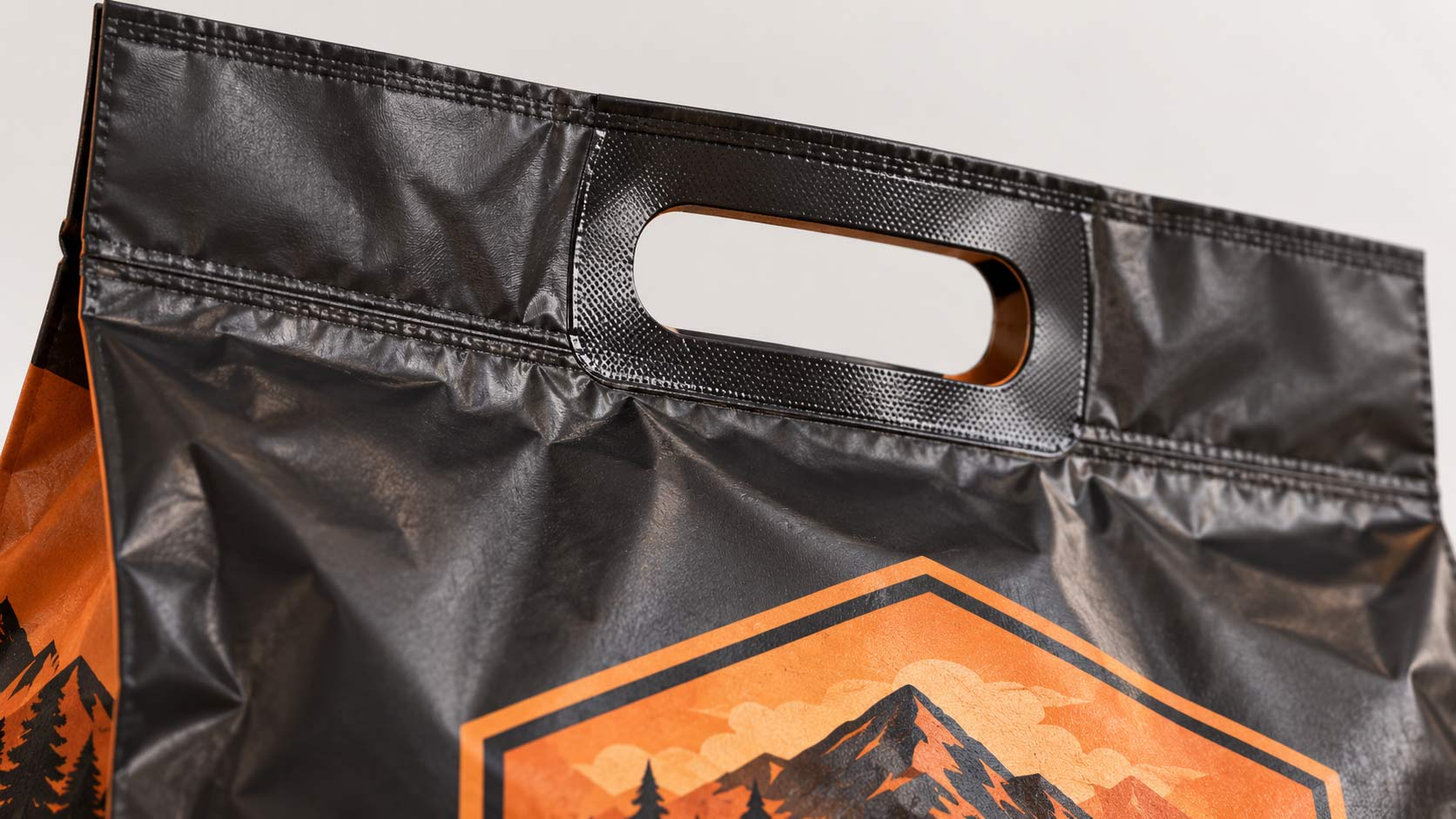
- A die-cut handle is a shaped hole cut through the top section of the bag, above the seal, through a reinforced patch laminated to the wall. The sealed chamber starts below it. The patch spreads the load so the cut edge does not tear, and the whole thing is part of the bag rather than an added part.
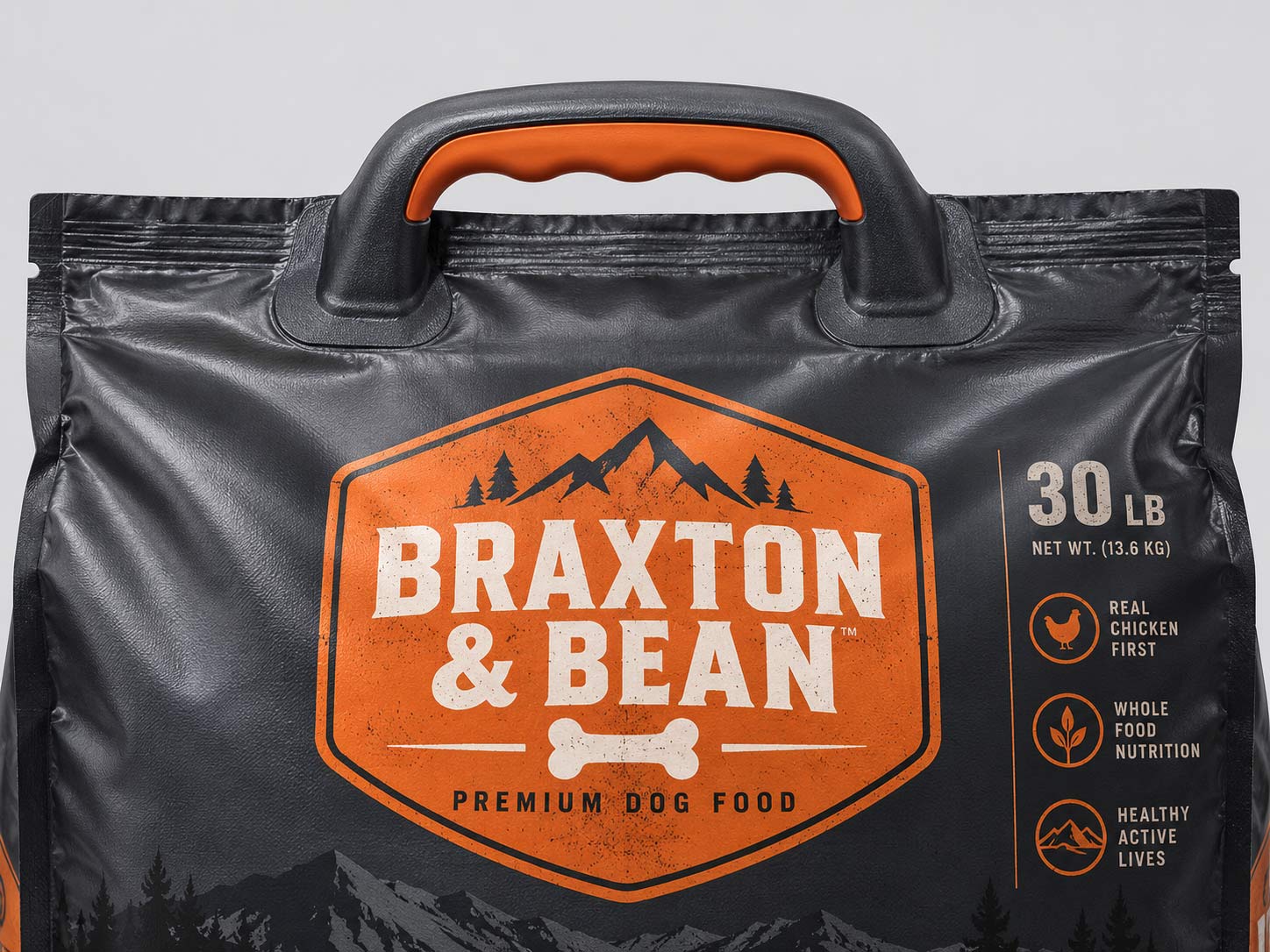
- An applied handle is a separate plastic or woven strap bonded to the outside of the bag. Nothing is cut through anything. It is the more comfortable of the two under real weight, and it is an extra component and an extra step.
The die-cut version is cleaner looking and keeps the bag a single object. The applied version carries more weight comfortably and does not rely on the bag's own film to hold up. Which one fits depends on how heavy the bag is and how premium it needs to feel.
What It Looks Like When It Goes Wrong
Handle failures are memorable, which is the problem.
- The handle tears out and a thirty pound bag hits the floor. The customer is holding a strip of film. This is almost always a missing or undersized reinforcement patch.
- The cut edge splits a little further every time the bag is lifted, so the second carry is worse than the first.
- The hole is placed too low and goes through the sealed chamber, so the bag is never airtight and the food goes stale early while nobody understands why.
- The handle is comfortable empty and unbearable full, because it is too narrow and concentrates the load into a thin line across the fingers.
The last one is not a safety issue and it is the one that costs you repeat purchases, because it is the one the customer feels every single time.
The Weight Where It Stops Being Optional
There is no universal number, but the pattern is consistent.
Small bags do not need a handle and often look better without one. Mid-size bags are where it becomes a genuine convenience that shoppers notice. Large bags are where its absence becomes a reason to buy a competitor, because at that weight the bag is awkward to hold any other way and people make the decision with their hands, not their eyes.
If you sell a range, the useful question is not whether to put a handle on everything. It is where in your range of bag sizes the handle should start, and whether the format changes at the same point.
Decide It Before the Dieline
A handle is not something you add later. It changes the top section of the bag, it changes where the seal sits, and on a die-cut handle it changes the structure because the reinforcement has to be built into the laminate.
That means it is a dieline decision, made alongside the bag style and the fill weight rather than after the artwork. It also eats design space: the top of your bag is prime real estate and a handle takes a piece of it, so your layout has to know it is coming.
A few things to settle before you commit.
- The maximum weight the bag will actually hold, not the average.
- Whether the handle is die-cut or applied, since it affects both cost and feel.
- Where the reinforcement sits and how far it extends past the cut.
- How the handle interacts with your closure, so opening and carrying do not fight each other.
- Whether every size in the line gets one, or only the large formats.
When you spec custom pet food bags, raise the handle at the same time as the size and the fat content. For large dry formats specifically, it belongs in the conversation about kibble and dry food bags from the start.
Wrapping It Up: The Feature Your Customer Holds
A handle is the only part of your packaging a customer grips with their whole hand, under load, in a parking lot, usually in a hurry. It is also the only part that has to be an opening in a package whose entire job is to have no openings.
Build it above the sealed chamber, reinforce it properly, make it wide enough to be kind to fingers, and decide it at the dieline rather than after. Get it right and nobody notices it, which is the highest compliment a handle ever gets.
Ready to Create Packaging Your Pets (and Customers) Will Love?
Let's bring your brand to life.
Get Started Today