
Your Bag Did Not Fail. The Seal Never Closed.
A pallet of kibble bags leaves the fill line looking perfect, and a week later there is product in the bottom of the shrink wrap. The bag gets blamed, and the bag is almost never the problem. A heat seal is a weld between two layers of film, and a weld cannot form through a layer of greasy kibble dust. Here is how that happens, why it shows up days later, and the five second test that catches it.
Overview
The bags came off the fill line looking perfect. Square, full, sealed flat across the top, stacked neat on the pallet. A week or two later somebody in the warehouse finds kibble in the bottom of the shrink wrap, or a retailer calls about a bag that was open on the shelf, or a customer posts a photo of a bag that came apart in the car.
The first instinct is that the bags were bad. It is a reasonable instinct and it is usually wrong. In most cases the film was fine and the seal simply never formed properly in the first place. It looked sealed, it held long enough to get through packing and shipping, and then it let go. Pet food is unusually good at causing this, for reasons that have nothing to do with the quality of the bag and everything to do with what kibble does while it is being poured.
A Heat Seal Is a Weld, Not Glue
To see why seals fail, it helps to know what a seal actually is, because most people picture something closer to tape.
The inside layer of a flexible bag is a sealant film chosen because it melts at a workable temperature. When the sealing jaws close on the top of a filled bag, they press the two inner faces together and heat them until that layer softens and the two sides flow into one another. When it cools, there are no longer two pieces of film touching. There is one piece of plastic. That is a weld, and a proper one is genuinely stronger than the film around it.
A weld like that needs three things people usually remember: enough heat, enough pressure, and enough time under the jaws. It needs a fourth thing that rarely gets written down, and that fourth thing is the one that fails in a pet food plant. The two faces have to be clean and actually touching each other.
Anything in the Seal Becomes Part of the Seal
This is the whole mechanism in one sentence, and it is worth being blunt about it.
Whatever is sitting between the two layers when the jaws close does not get pushed out of the way. It gets melted into the joint. Plastic cannot weld to plastic in the spots where something else is in between, so instead of one continuous seal across the top of the bag, you get a seal with gaps in it. A fine dusting across the seal area can leave a line that looks completely normal from the outside while being, structurally, a row of small bridges with holes between them.
Oil is worse than dust, because oil does not burn off or melt in. It sits there as a film and keeps the two layers from ever making contact. A seal contaminated with fat can look flawless and have almost no strength at all.
Why Pet Food Is the Worst Case
Plenty of products are dusty. Pet food manages to be dusty and greasy at the same time, which is the specific combination that ruins seals.
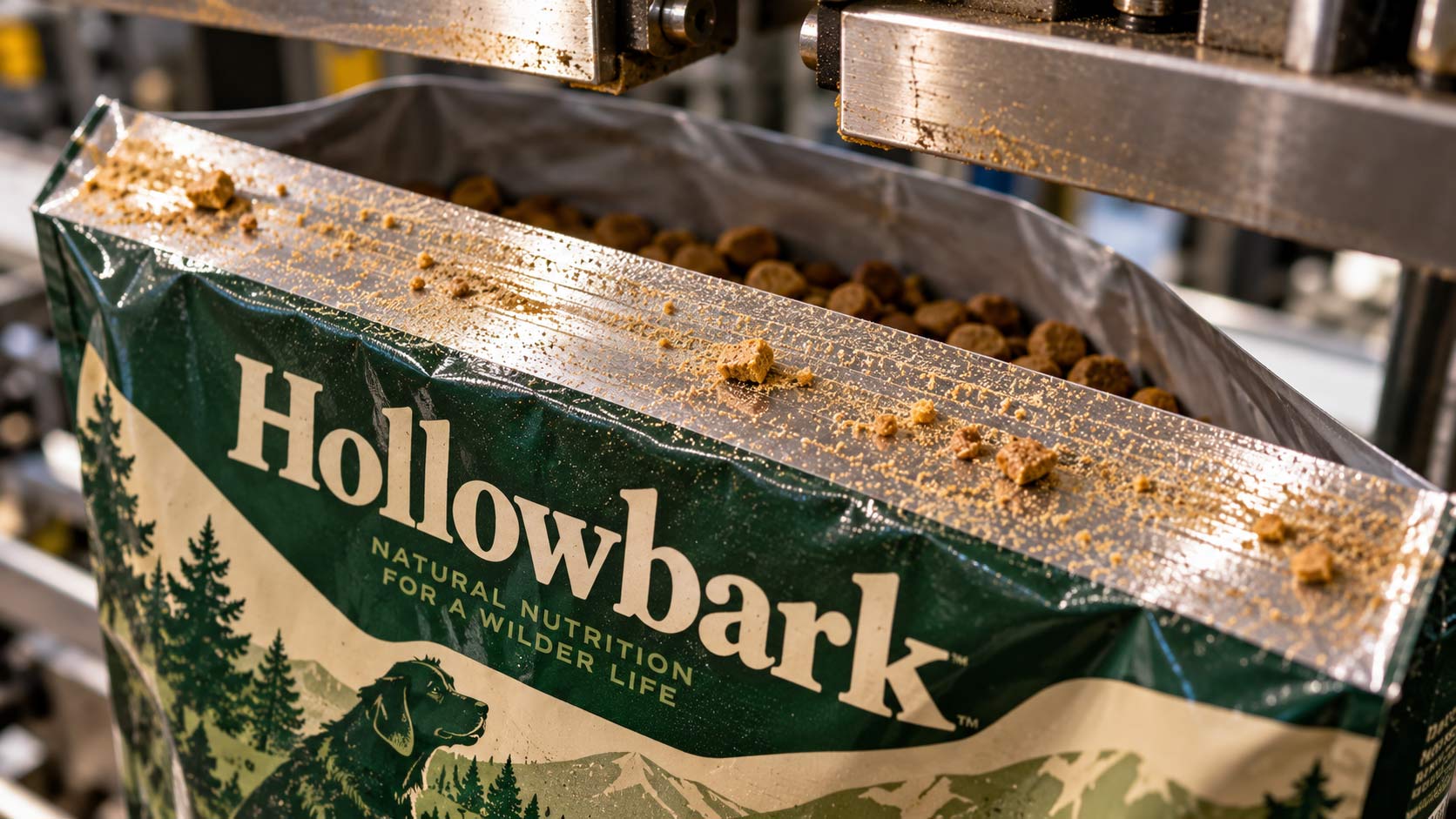
Kibble is an extruded, abrasive product that sheds fines constantly as it moves through hoppers and down a fill tube. On top of that, most dry pet food is coated after extrusion with fat and palatant, the layer that makes it appealing to the animal. That coating is on the outside of every piece. So the dust coming off kibble is not clean dust like flour, it is oily dust, and it goes airborne in the exact moment the bag is being filled, right below an open seal area waiting to close.
- Kibble fines and broken pieces thrown up by the drop into the bag.
- Fat and palatant carried on that dust as a fine oily mist.
- Freeze dried and raw powder, which is light, clingy, and travels further than kibble dust.
- Treat crumbs and coating sugars, which are sticky rather than greasy and cause the same gap.
- Ordinary room dust and static cling on fresh film, which attracts fines to the seal area before anything is even poured.
Every one of those ends up in the same place, which is the two inches at the top of the bag that have to become a weld a few seconds later.
Why It Shows Up Later and Not at the Fill Line
The delay is the reason this gets misdiagnosed so reliably, and it is worth understanding because it shapes where you go looking.
A partly welded seal is not an open bag. It has real strength, just much less than it should, and nothing at the end of the line is stressing it. The bag gets packed, palletized, and wrapped while the seal is still comfortably within what it can hold. Then it goes into the world and starts collecting load. Bags underneath a stack carry weight. A warm truck softens the film and raises the pressure of the air inside. Every handling step flexes the top of the bag a little more.
Somewhere in that sequence the weak points give way, and by then the bag is far from the fill line and nobody connects it back. A seal problem that began as a dusty two seconds in your own facility arrives looking exactly like a defective bag from your supplier.
The Peel Test That Tells You in Five Seconds
The good news is that you do not need equipment to catch this. You need one bag and your hands.
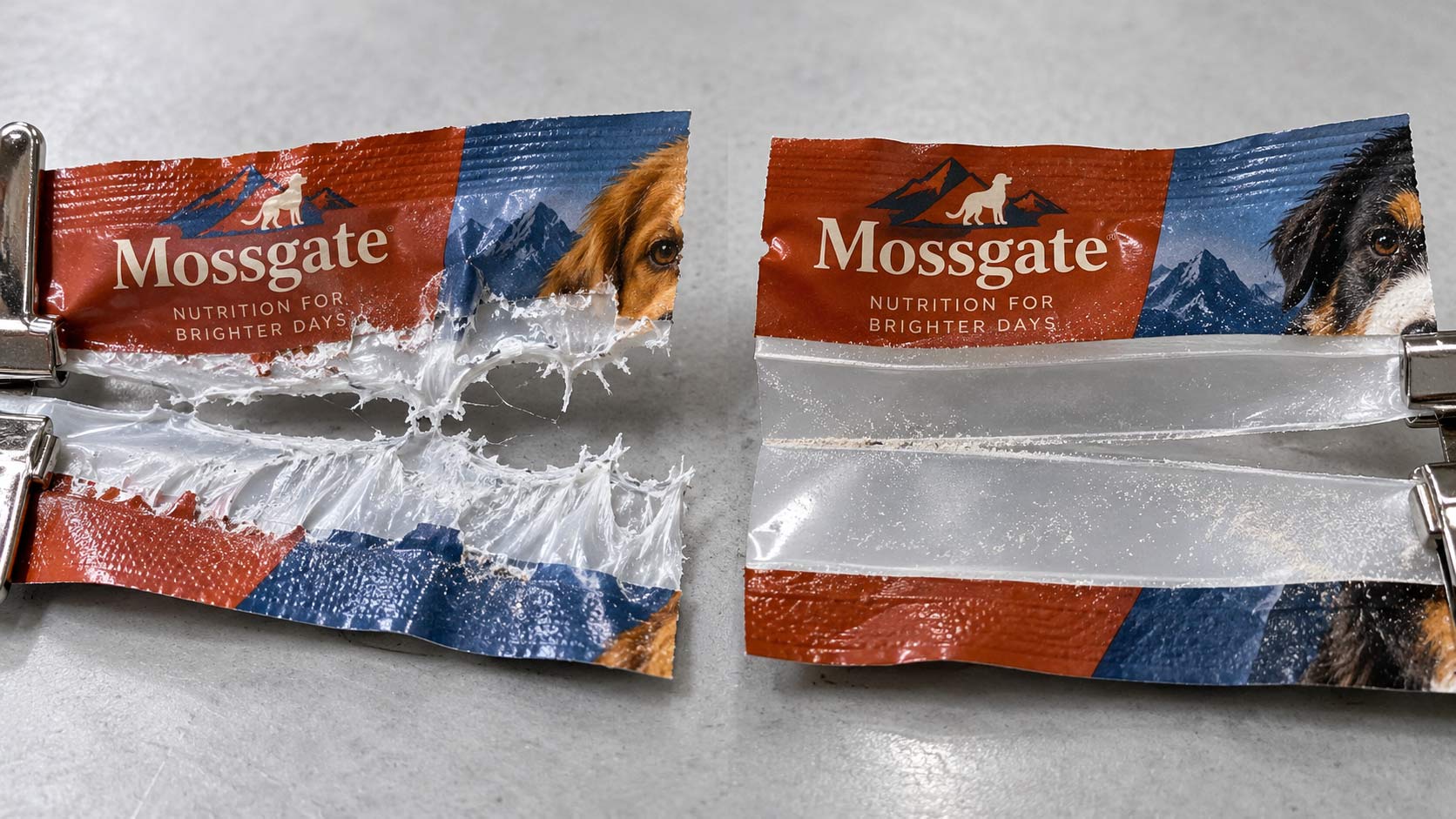
Take a sealed bag, cut a strip across the seal, and pull the two sides apart. What you are looking for is how it comes apart, not how hard it was. A proper weld will not separate cleanly at all. The film will stretch, distort, and eventually tear somewhere, often beside the seal rather than in it, because the joint is stronger than the material. That is exactly what you want to see.
A contaminated seal does the opposite. It peels apart smoothly and the two faces come away clean and shiny, with the original surfaces intact and no stretching. That clean peel is the tell. It means the layers were never one piece of plastic, they were two pieces lightly stuck together. Pull a bag from the start of every run and another from the middle, and you will catch this on the day it happens instead of a month later.
Fixes That Actually Work
Almost everything that solves this is a fill line habit rather than a purchase, which is why it is worth knowing about.
- Keep real headspace between the product level and the seal. Filling to the top guarantees dust and product in the seal area, and it is the single most common cause.
- Wipe or air the seal area before closing, with a wipe down between runs and a clean air blow if your line allows it.
- Clean the sealing jaws on a schedule. Baked on fat and residue build up on the jaws themselves and transfer back onto the film.
- Slow the drop or let the dust settle for a moment before the jaws close, since most airborne fines fall quickly if given the chance.
- Destructively test the first bag of every run, and never test only the ones that look wrong.
Those five cost nothing but attention, and together they eliminate the large majority of seal failures in a dry pet food operation.
Where the Bag Itself Does Matter
None of the above means the bag is irrelevant, and a few specification choices make a contaminated seal much less likely to turn into an open one.
A wider seal area gives you more margin, because a gap in the middle of a generous weld still leaves sealed material on either side of it. The sealant layer matters too, since some are far more tolerant of a little contamination than others, and that is a conversation worth having when you spec custom pet food bags or move up to larger kibble sizes. Bag size matters more than people expect, because a bag that is slightly too small for the fill weight forces product right up into the seal zone, which we covered in our post on pet food bag sizes. For treat packaging and raw and freeze dried food, the contamination tends to be sticky or powdery rather than oily, so the same discipline applies with a different mess.
It is worth separating this from a problem it resembles. Fat working its way through the bag over time and showing as a dark patch is a different mechanism entirely, covered in our post on pet food bag grease resistance. That one is about the material. This one is about two seconds at the top of the bag.
Wrapping It Up: Watch the Two Inches at the Top
A bag that opens in the field feels like a supplier problem, and it is one of the few packaging failures that usually is not. The film did its job. The structure did its job. The weld that was supposed to close the whole thing never fully formed, because something greasy and microscopic was lying across the seam when the jaws came down.
Leave headspace, keep the seal area and the jaws clean, give the dust a second to settle, and peel one bag from every run to see whether it tears or slips apart. Those habits take minutes a day and they protect the part of the package that every other part depends on. Your barrier film, your zipper, and your print all stop mattering the moment the top of the bag comes open in somebody's kitchen.
Ready to Create Packaging Your Pets (and Customers) Will Love?
Let's bring your brand to life.
Get Started Today